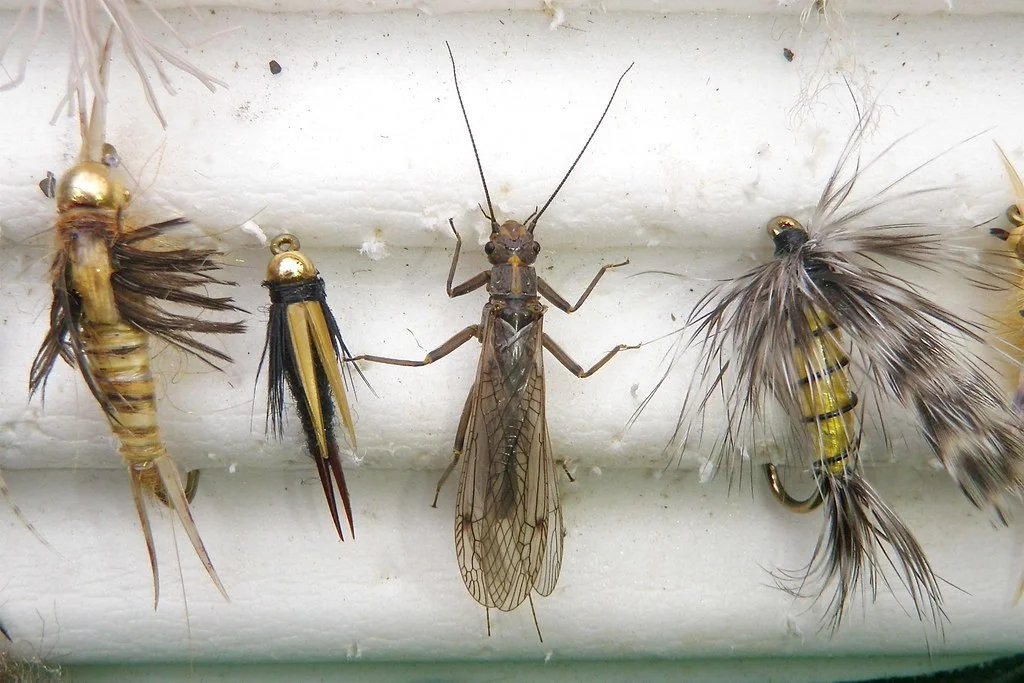
Golden stoneflies
The hatch you're already fishing — if big foam attractors are working in July and you don't know why, this is why.
Species
Hook sizes
Season
The night shift
Golden Stoneflies have a reputation problem. They're overshadowed by the Salmonfly — bigger, more dramatic, earlier in the season — and by the time Golden Stones are peaking, most anglers who showed up for the Salmonfly have gone home. What they left behind is often better fishing.
Here's what most anglers miss: Golden Stoneflies emerge primarily at night. You won't see them coming off the water the way you'd watch a mayfly hatch. You won't witness the classic emergence chaos. What you'll see during the day is a handful of adults on streamside rocks and willows, a few clattering around in the air, and fish eating large foam flies with a confidence that seems out of proportion to what's visible.
That confidence is earned. The fish have been feeding on Golden Stone adults overnight, and they stay in that big-dry-fly eating mode for days at a stretch even after the visible activity has quieted. Which means that during Golden Stone season — June and July on most Western freestone rivers — throwing a size 6 to 10 attractor pattern along the banks is not a random choice. It's matching a hatch that happens to run on a schedule you're not awake for.
→ For stonefly biology, nymph behavior, and life cycle, see the Stoneflies article in What Fish Eat.
Golden Stones are a different fishing experience than Salmonflies
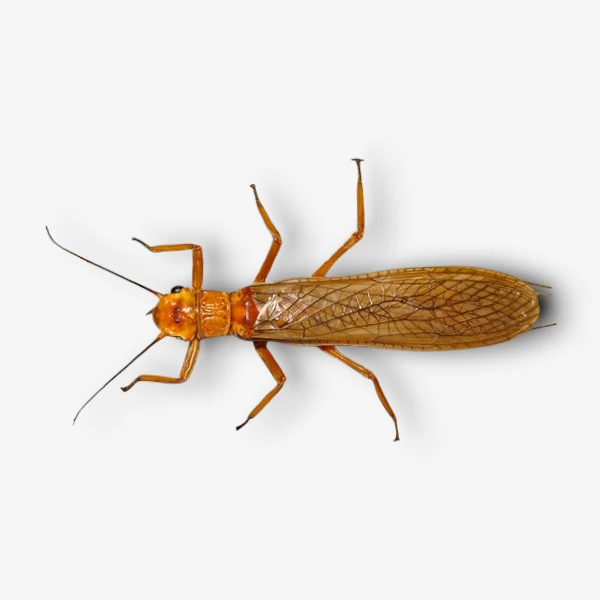
The Salmonfly gets the attention, and deservedly — the emergence is spectacular and the fishing during peak can be extraordinary. But the Golden Stone has practical advantages that make it, for many anglers on many days, the more productive hatch to fish.
Longer window. The Salmonfly hatch on a given section of river lasts days. The Golden Stone emergence runs for weeks. Fish stay primed for large surface flies over a much longer period, which gives you more opportunities to be in the right place without the pressure of a narrow window.
Less pressure. The Salmonfly brings crowds. The Golden Stone, despite following closely behind, does not. The anglers who specifically chase Golden Stone fishing are a smaller group, and the fish they're targeting have seen fewer flies.
Better water conditions. Salmonfly hatches coincide with peak runoff on many Western rivers — high, fast, sometimes off-color water that complicates presentation. Golden Stones emerge a few weeks later, after runoff has receded and rivers have dropped and cleared. The fishing is technically easier even though the fish are equally willing.
Productive throughout the day. While the actual emergence is nocturnal, Golden Stone adults are active during daylight hours — flying clumsily, falling onto the water, crawling along bankside vegetation. Unlike the Salmonfly, which often concentrates its best action in a specific window, Golden Stone fishing can be productive from morning through evening.
Timing and geography
Golden Stones emerge after the Salmonfly on any given river — typically two to three weeks behind on the same water, progressing upstream through the elevation gradient in the same way. On many Western rivers the sequence runs: Salmonfly on the lower river in late May, Golden Stones following through June, with the hatch reaching higher elevations in July.
Water temperature drives timing here as with all stoneflies. Golden Stone nymphs begin migrating to the banks when water temperatures reach the mid-to-upper 50s °F — slightly warmer than what triggers Salmonflies. On rivers with cold summer temperatures the hatch can extend well into August at higher elevations.
The overlap zone is worth knowing. There's a window on most Western rivers — typically early to mid-June — where Salmonfly activity is tapering on upper sections and Golden Stones are building. Both patterns in the box, fish the bank, adjust based on what you're finding in the willows.
IdentaFly's hatch forecast helps you line up temperature trends with when large stoneflies are likely to matter — then confirm with a shop on the exact section you're chasing.
Where to be
Western rivers
Idaho
When
Late June
Notes
Overlaps Green Drake hatch; large dries productive almost continuously during overlap
When
June through July
Notes
Premier float water; willow-lined banks; straightforward and productive
Montana
When
June into July (upper sections)
Notes
Crowds gone after Salmonfly; fish have recovered; upper sections into mid-July
Deschutes River
Oregon
When
June into July
Notes
Canyon sections; float access; river settles into summer rhythm after Salmonfly
Colorado
When
June through July
Notes
Good public wading access; less pressure than famous tailwaters
Montana
When
Late June
Notes
Overlaps Salmonfly tail; high water may still be a factor; bank-tight approach
How to fish it
Fish the bank
Golden Stone nymphs migrate to the bank before emerging. Fish follow. Cast tight to overhanging willows, under cutbanks, into the slack pockets at the edge of fast current. Mid-river presentations during active Golden Stone fishing are largely wasted casts.
Fish all day
Unlike the Salmonfly, Golden Stone fishing is productive from morning through evening. Early morning because fish fed throughout the night and are still in bank-focused mode. Afternoon because adult Golden Stones become active in the warmth and end up on the water. Evening because the overnight emergence is approaching. Pick a productive bank-water stretch and work it throughout the day.
Cover water
Golden Stone fishing is not about picking individual rising fish and presenting to them with precision. It's about covering productive bank water systematically — cast tight to the bank, drift, pick up, move a step or two, repeat. Think of it as searching with a dry fly rather than presenting to a specific target.
Vary the presentation
Dead-drift is usually the starting point and often the right choice. But Golden Stone adults flutter and skitter, and a slight twitch or intentional drag on a foam pattern can trigger strikes from fish that ignored the dead-drift version. Experiment, especially in the afternoon when naturals are most active on the surface.
Don't overlook the nymph
Golden Stone nymphs spend two or more years on the bottom before emerging — which means they're available to fish year-round in rivers where the species is present. A size 6 to 8 golden stonefly nymph fished deep along the bank produces before, during, and after the hatch window, and through the late summer and fall when no surface activity is apparent.
What to carry
Dry flies
- Stimulator, sizes 6-10, yellow or golden body — the standard and still one of the best
- El Camino Grillo, sizes 6-10 — yellow or olive-gold body, realistic silhouette
- Chernobyl Ant or foam attractor in yellow or tan, sizes 6-10 — floats all day, handles fast water
Nymphs
- Kaufmann's Golden Stone, sizes 6-10 — weighted, fished deep along the bank
- Pat's Rubber Legs in golden or yellow, sizes 6-8
- Agent Orange, sizes 8-10 — a reasonable proxy when nothing more specific is at hand
Tippet
2X to 3X. Big flies, likely big fish, bank structure that requires landing fish quickly before they wrap around something.
The understated hatch
Golden Stoneflies don't have the Salmonfly's reputation or the mystique of the Green Drake. There are no rivers specifically known for their Golden Stone fishing the way the Au Sable is known for the Hex. The hatch doesn't attract its own crowd or generate its own lore.
What it does is produce reliable, productive dry fly fishing on most major Western freestone rivers through June and July — often better fishing than the more celebrated events that preceded it, with less competition for the water and fish that haven't been pounded for three days.
The anglers who pay attention to it tend to keep that information reasonably close.