The hatch that moves
You don't schedule it. You chase it.
Species
Hook sizes
Season
What you're getting into
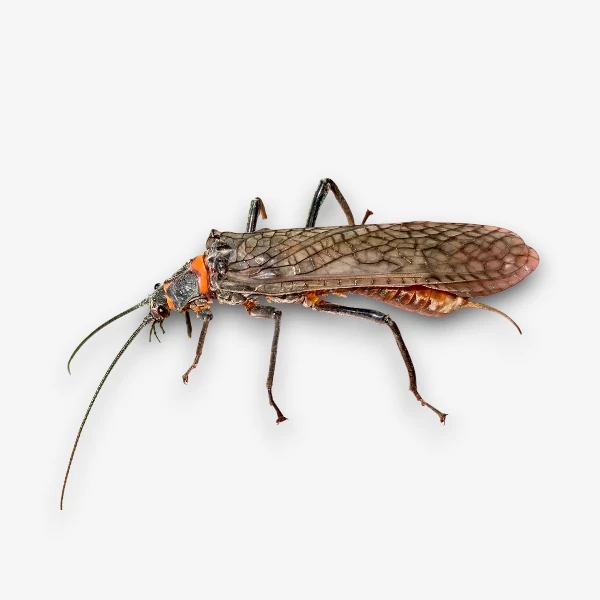
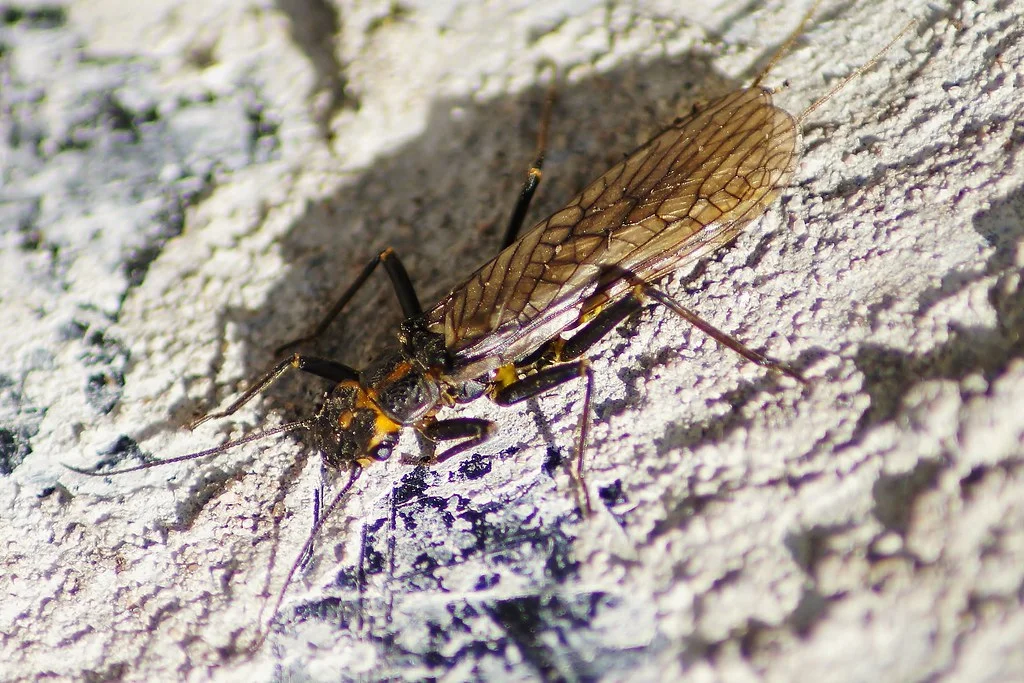
The Salmonfly hatch is not a quiet affair. These are two-inch insects with bright orange abdomens, and when they're on the water they are impossible to ignore — clinging to streamside willows in numbers, landing on your rod, your waders, your lunch. On a river in full Salmonfly emergence, the smell of them is detectable from the bank before you can see them.
The fish respond the same way you do. Browns and rainbows that have been deep and cautious move to the edges and eat with a confidence that borders on stupid. Big foam flies dropped against the bank get crushed. It's the closest thing to guaranteed dry fly fishing that exists — when you're in the right place at the right time.
That second part is where most anglers come up short.
→ For stonefly biology, life cycle, and nymph behavior, see the Stoneflies article in What Fish Eat.
The moving hatch
The Salmonfly hatch doesn't happen everywhere at once. It progresses upstream as water temperatures rise through spring — typically moving several miles a day on a given river, sometimes faster. Lower sections of a river emerge weeks before upper sections. The hatch on one drainage may be finishing while another hasn't started.
This is what makes Salmonfly fishing both predictable and maddening. The progression is consistent year to year in its general shape. But the exact timing shifts with snowpack, spring temperatures, and runoff — sometimes by two or three weeks in either direction. A cold, late spring compresses everything. A warm March pushes the hatch early and fast.
The classic mistake: booking a fixed trip date based on average timing and arriving to find the hatch already gone on your target section, still building on the section below, or suppressed by a cold snap. It happens constantly. The anglers who consistently fish the Salmonfly well treat it like a weather event — they watch conditions in real time, stay flexible, and move when the window opens.
How to time it
Water temperature is the trigger. Salmonfly nymphs begin migrating to the banks when water temperatures consistently reach the mid-to-upper 40s °F, and the main emergence happens as temperatures push into the low 50s. Watch temperature trends on your target water, not just air temperatures — a string of warm days can move the hatch faster than you expect.
A few reliable indicators that you're close:
- Shucks on the rocks. Salmonfly nymphs crawl out of the water to emerge on boulders and bankside vegetation. If you're seeing empty shucks — the split exoskeletons left behind — the hatch has started on that section. If shucks are fresh and abundant, you're in the middle of it. If they're old and dried out, you've missed it there.
- Adults in the willows. When Salmonflies are present in numbers you'll see them on streamside vegetation before you see them on the water. A few adults in the willows means the hatch is building. Dense concentrations mean peak is happening or has just happened.
- Fishing reports from the section below. If the lower river is reporting good Salmonfly fishing this week, your upper section is probably two weeks out, give or take. Track the progression and plan accordingly.
IdentaFly's hatch forecast tracks water temperature conditions that correspond to Salmonfly emergence windows — useful for narrowing down which section of a river system to target before you make calls to local shops.
Calling the shop
No forecast replaces a call to a shop that's been on the water. This is particularly true for Salmonfly fishing, where the difference between peak and post-peak on any given section can be a matter of days.
A good shop call for Salmonfly timing covers three things: where on the river the hatch is right now, how long they expect it to stay there, and whether conditions — flow, clarity, weather — are actually fishable. High water from concurrent snowmelt is a constant variable on Salmonfly rivers, and a river that's technically in the hatch window can still be blown out and unfishable. The shop knows. Ask specifically.
Where to be: the key waters
Western freestone and tailwater classics — same detail as a hatch table, without the horizontal scroll.
Western rivers
Deschutes River
Oregon
When
Late April through May
Notes
Earliest major event of season; float access through canyon; cold and clear
Montana
When
Late May to early June
Notes
High water common; bank-tight approach works even in off-color conditions
Montana
When
Late June
Notes
Overlaps Golden Stones; fewer crowds than Madison; big water, boat helps
Colorado
When
Late May into June
Notes
Wade fishable canyon water; good public access; hatch moves upstream through Numbers
Utah
When
Late spring
Notes
Regulated flows from dam make timing more predictable than free-running rivers
Idaho
When
Late May through June
Notes
Premier float water during the hatch; long driftable stretches with good access
How to fish it
Fish the bank
The central tactical point of Salmonfly fishing. The nymphs migrate to shore before emerging, concentrating fish in shallow water at the river's edges — not in the middle of the current where you might normally look. Cast tight to overhanging willows, into the seams between fast current and slack pockets near the bank, under cutbanks. The further you cast from shore during the main event, the less likely you are to find fish.
Use foam
Traditional feather-wing dry flies look beautiful in the hand and sink on the second cast in the fast, choppy water that Salmonfly rivers run during hatch season. Foam patterns — Chernobyl Ants, Turk's Tarantulas, large Stimulators — float all day, handle sloppy presentations, and are visible from a distance. Size 4 to 6, orange or rust underbody. This is not the time for delicate patterns.
Don't neglect the nymph
The migration of Salmonfly nymphs to the banks happens over days before the main emergence. During this period — and in the days following peak, when adults are tapering off — a large black stonefly nymph drifted deep along the bank can be the most productive setup on the river. Fish stop crashing dry flies after a few days of heavy feeding. The nymph keeps working.
High water is not your enemy
Most Salmonfly rivers are running elevated and sometimes off-color during the hatch — snowmelt peaks at the same time the hatch does on many Western rivers. Resist the instinct to wait for clearer water. Fish stack in the slack pockets and eddies that high water creates along the bank. The bank-tight approach that works during normal conditions works even better when fish have fewer places to hold.
What to carry
Dry flies
- Chernobyl Ant, sizes 4-6, orange or rust — the reliable workhorse
- Turk's Tarantula, sizes 4-6 — good silhouette, floats well in fast water
- Stimulator, sizes 4-8, orange body — covers both Salmonfly and Golden Stone
Nymphs
- Kaufmann's Black Stone, sizes 4-8 — weighted, fished deep along the bank
- Pat's Rubber Legs, sizes 4-6 — productive before, during, and after the hatch
- Any large dark stonefly nymph with rubber legs
Tippet
2X or 3X. These are big flies and the fish are often large. Don't go lighter.
The short version
The Salmonfly hatch rewards anglers who stay flexible and pay attention to where the hatch is in real time, not where it's supposed to be based on a calendar. Watch water temperatures, talk to local shops, and be willing to adjust on short notice. When you're in the right place at the right time, fish the bank with big foam flies and don't overthink it.
The window on any given section is short. The fish make it worth finding.