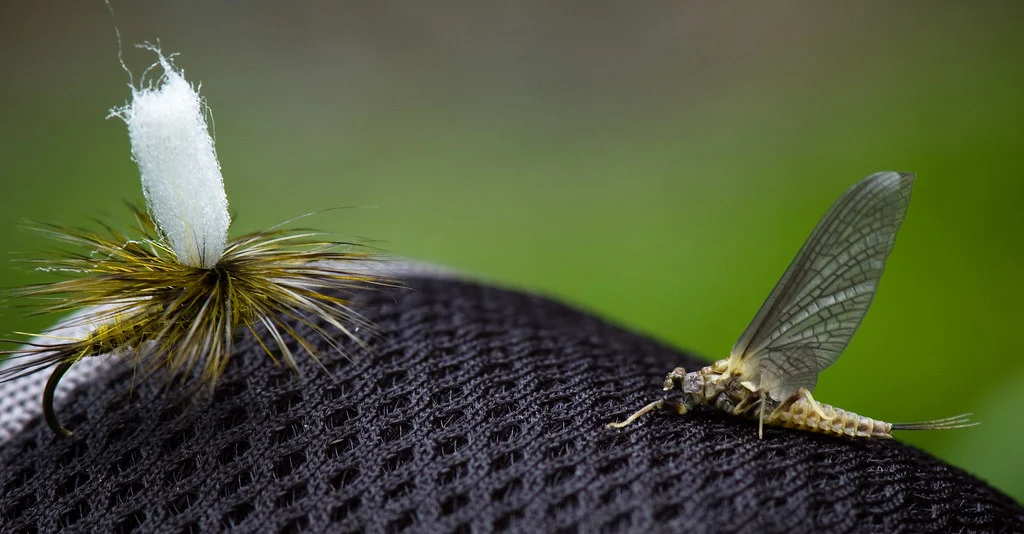
The hatch that changes the river
Two species, two coasts, one window — don't miss it.
Species
Hook sizes
Season
What happens when Green Drakes come off
Most trout fishing involves finding fish. During a Green Drake hatch, the fish find you. Browns that haven't shown themselves in weeks appear in feeding lanes. Fish that normally hold tight to cover move into open water and feed with a confidence that looks almost reckless. The rises are deliberate, unhurried, and visible from a distance. For a window that might last ninety minutes on a bright day and several hours when it's overcast, the river reorganizes itself entirely around this one insect.
This is what separates a Green Drake event from an ordinary hatch. It's not just that the fish are eating — it's that the fish are all eating, in places you can see them, on a fly large enough to track on the water. For dry fly anglers, it's close to ideal.
It's also the hatch with the widest geographic range on this list — significant events on Eastern limestone streams in late May, Western freestone rivers through June and July, and high-elevation tailwaters running as late as October. Which means that if you miss it on one water, it's probably happening somewhere else.
→ For the biology — life cycle, nymph behavior, emerger vs. dun feeding — see the Mayfly article in What Fish Eat.
East vs. West: two different events
The Eastern and Western Green Drakes share a common name and similar fishing experience, but they're different species with different timing, different water types, and enough variation in approach that they're worth understanding separately.
Eastern Green Drake (Ephemera guttulata)
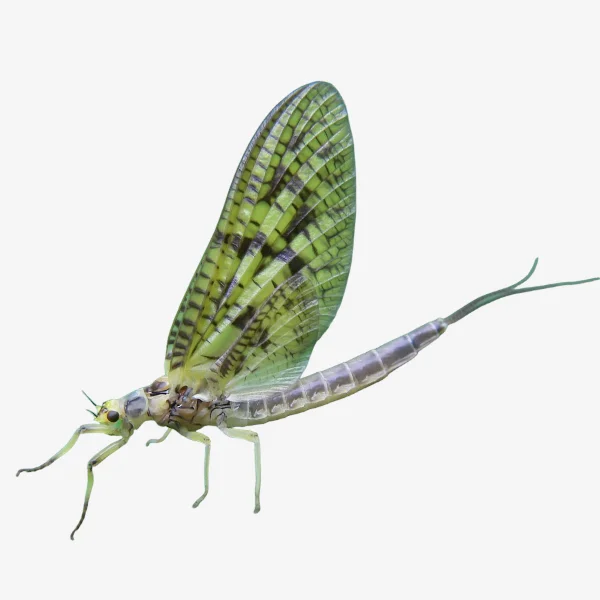
Hatches on limestone spring creeks and cold freestone streams across Pennsylvania, New York, and New England, primarily in late May and early June. The water it prefers is cool, clear, and rich — the kind of stream that produces large wild brown trout. The hatch is afternoon-heavy, typically coming off between 2 and 6 PM, with a Coffin Fly spinner fall at dusk that many anglers consider the better fishing of the two events.
The Eastern drake is larger than most anglers expect — size 8 to 10 — and the fish eat it with appropriate commitment. What makes Eastern Green Drake fishing challenging isn't technical selectivity. It's the combination of pressure, wild fish that have seen a lot of flies, and a spinner fall that happens in low light when presentations are hardest to control.
Western Green Drake (Drunella grandis)
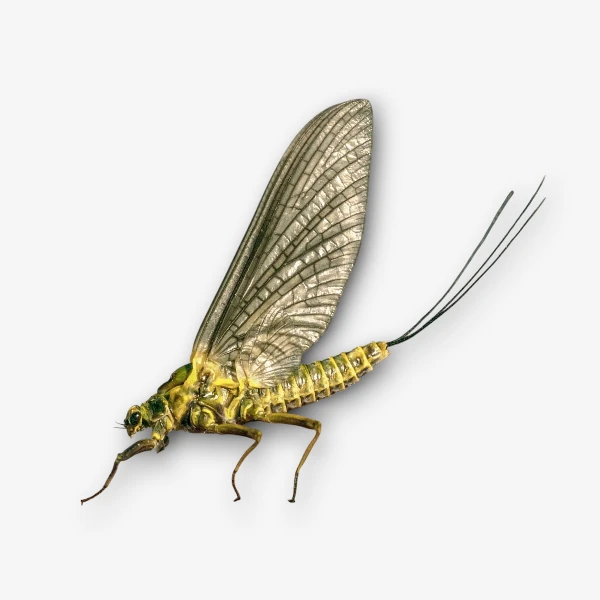
Hatches on cold freestone rivers across the Rocky Mountain West, generally in June and July at lower elevations and extending through September at higher ones. Slightly smaller than the Eastern species — size 10 to 12 — and hatches in the afternoon on sunny days, often compressed into a short window when temperatures peak. Overcast days extend the hatch significantly, sometimes producing emergences that run for hours rather than ninety minutes.
Western drake water tends to be faster and more varied than Eastern limestone creeks, which changes the fishing. Presentations are less exacting because the broken surface gives fish less time to inspect a fly. The trout are often larger, particularly on tailwater sections below reservoirs. And the summer timing means the hatch overlaps with other significant events — Golden Stones on freestone rivers, PMDs on slower sections — which makes trip planning more flexible.
Figuring out the Green Drake hatch timing
Green Drakes are an elevation-sensitive hatch. The same insect that's hatching on a low-elevation river in late May won't appear at 8,000 feet until July or August. This is both a complication and an opportunity.
The complication: you can't pick a fixed date. A cold spring delays the hatch; a warm one accelerates it. Water temperature is the trigger — Western drakes typically emerge when afternoon water temperatures reach the low-to-mid 50s °F, which happens at different times depending on the year, the river, and the elevation.
The opportunity: the elevation gradient gives you multiple shots at the same hatch on the same river system. Miss the Roaring Fork in late June and the upper Frying Pan may still be going in August. Miss Penns Creek over Memorial Day weekend and the upper reaches may have drakes a week later.
The practical approach:
- Watch water temperature reports, not dates. When afternoon water temps are climbing into the low 50s on your target water, you're getting close.
- Call the local shop the week before you plan to go. A shop that guides that water knows where the hatch is and whether it's building or tapering.
- Build in flexibility. A long weekend beats a fixed Saturday. A week beats a long weekend.
IdentaFly's hatch forecast uses real-time water temperature data to show where and when drake conditions are developing — a useful first filter before you start making calls.
Where to be: the key waters
East
Pennsylvania
When
Peaks Memorial Day weekend
Notes
C&R section Coburn to Cherry Run; Coffin Fly spinner fall at dusk
New York
When
May 20-23 lower, mid-June upper
Notes
Wild rainbows and browns; less crowded than Penns Creek
New York
When
Late May through early June
Notes
Classic Catskill water; explore beyond obvious access points
Check out Dark Skies Fly Fishing, out of the State College, PA area.
West
Idaho
When
Opens June 15; hatch begins within days
Notes
Flat, slow, educated rainbows; overcast days dramatically better
Colorado
When
Late June through July
Notes
Faster water; fish slower edges and pocket water during the hatch
Montana
When
Late June; overlaps Golden Stones
Notes
Fish already primed for large surface flies; cover water
Colorado
When
Mid-June through July
Notes
Lower pressure due to access; extends the Colorado drake season
How to fish it
The cripple question
Green Drakes have an unusual emergence — they unfold their wings below the surface and push upward rather than popping through the film. This means they're stuck in a vulnerable transitional state longer than most mayflies, and trout know it. A cripple pattern — a dun imitation tied to sit flush in the film rather than ride high on hackle — will consistently outperform a standard parachute pattern during the main emergence. Start with the cripple. Switch to a high-riding dun only if fish are clearly eating off the top.
The spinner fall
On Eastern rivers particularly, the Coffin Fly spinner fall at dusk is often the best fishing of the event. Spent adults lie flat with wings horizontal, nearly invisible in low light. Fish sipping rhythmically and refusing your dun patterns in the evening almost certainly means spinners. Look for the slight iridescent glint of wings on the surface, switch to a flush-riding spent pattern, and lengthen your drift.
Reading the water during the hatch
During a heavy emergence, fish spread out from their typical holding lies and move into feeding lanes. Don't assume fish are where you'd normally find them. Watch for rises in open water, in tailouts, in places that would normally be unproductive. The hatch moves fish — follow the rises, not the structure.
Tippet
Heavier than you think. The flies are size 10-12 and the fish are often large. 2X or 3X fluorocarbon tippet is appropriate and won't cost you fish the way lighter tippet might during a long fight in cold water. Save the 5X for the Trico hatch.
What to carry
Dun patterns
- Parachute Green Drake, sizes 10-12 — visible in faster water, floats well
- Comparadun or Sparkle Dun, sizes 10-12 — sits lower, better in flat water
Cripple patterns (don't skip these)
- Challenged Drake, sizes 10-12 — the most important and most underrepresented pattern in visiting anglers' boxes
- Any standard dun pattern trimmed to sit flush in the film works in a pinch
Spinner patterns
- Green Drake Spinner (West) — dark body, clear or white spent wings, sizes 10-12
Nymphs
- Hare's Ear or Green Drake Nymph, size 10-12 — fish in the hour before the emergence. Fish are eating nymphs before you see a single adult on the water.
The one thing
The Green Drake hatch is not something you stumble into. It requires intention — watching the calendar, monitoring conditions, making the call at the right moment, showing up with the right flies in the box.
Pick a river. Learn its typical timing. Watch the water temperature reports in the weeks before. Call the shop. Go with flexibility built into your schedule.
The window is short. It's worth the effort.