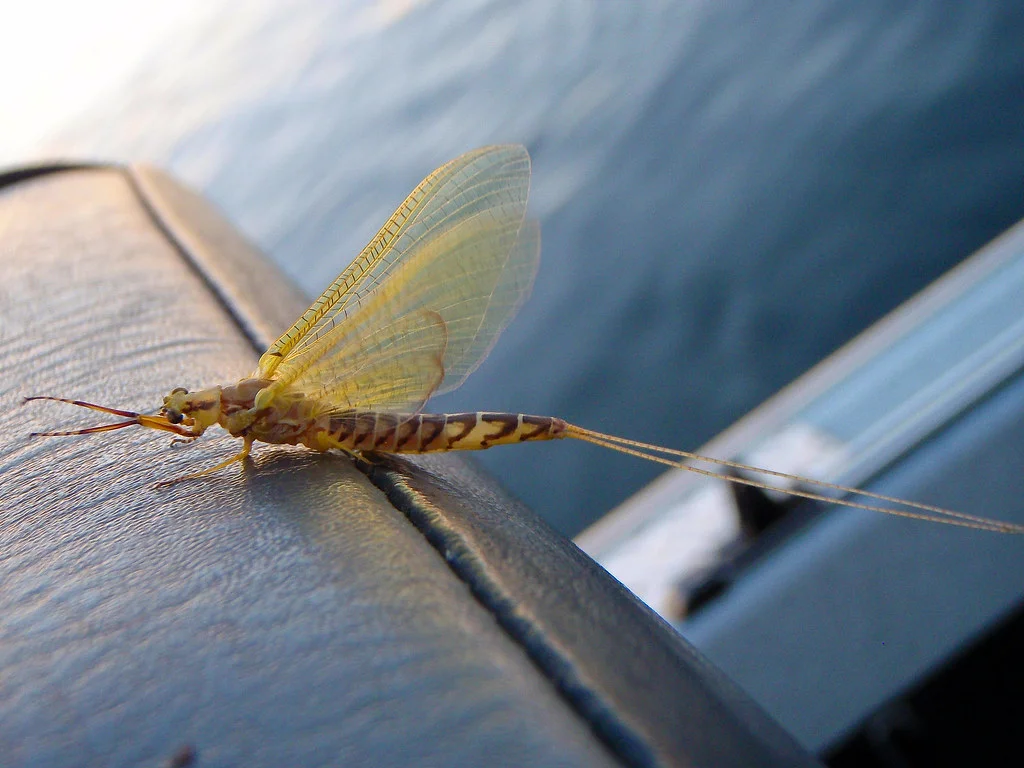
The Hex hatch
The biggest mayfly in North America. The biggest brown trout of your season. Midnight.
Species
Hook sizes
Season
A different kind of fishing
Everything about the Hexagenia hatch is backwards from normal fly fishing. You sleep through the morning. You eat dinner on the river. You don't start fishing until most people have gone to bed. Your best cast of the night is one you can't fully see. And the fish — the large, cautious, largely nocturnal brown trout that make this hatch worth the effort — are eating a size 4 mayfly in complete darkness with an aggression they'd never show in daylight.
If that sounds appealing, you're going to love Hex fishing. If it sounds impractical, that's fair — it is. But there is no other dry fly event in North America where the average size of fish eating off the surface comes close to what happens on a good Hex night. These are not typical rising trout. These are fish that have been growing in deep, slow water for years, feeding primarily at night, and the Hex emergence is the one event of the year when they consistently come to the surface in numbers.
→ For mayfly biology and life cycle basics, see the Mayfly article in What Fish Eat.
What Hexagenia is
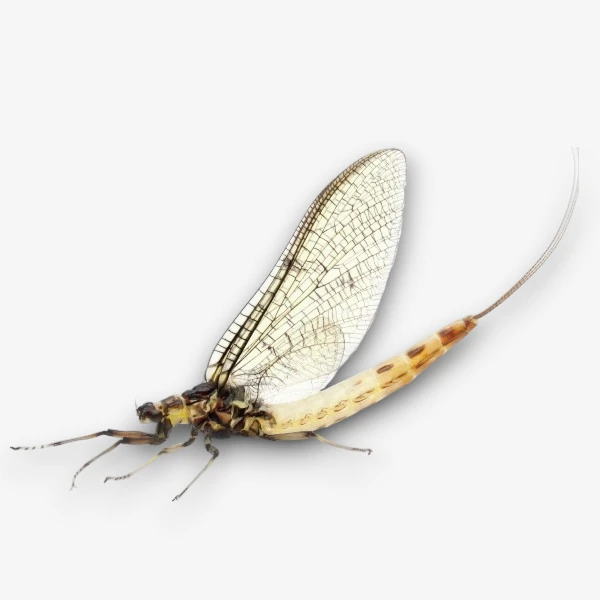
Hexagenia limbata is a burrowing mayfly — which is the key to understanding both where it lives and why it matters. Unlike most aquatic insects that cling to rocks or vegetation on the stream bottom, Hexagenia larvae burrow into soft sediment: the mucky, silty substrate of slow river sections, lake margins, and spring-fed flats. They live there for one to two years before emerging.
This habitat requirement is why the Hex hatch doesn't happen everywhere. Fast, rocky freestone rivers don't have it. Cold tailwaters with scoured gravel bottoms don't have it. The Hex requires soft, organic-rich substrate and slow water — the kind of environment that's common in Northern Michigan's river systems, where glacial geology created exactly the right conditions.
The adults are enormous by mayfly standards. Size 4 to 8 on a standard hook, with long tails and a pale yellow-olive body that's visible even in low light. When they emerge in numbers they're unmistakable — and so is the sound of large brown trout eating them.
The timing
June is the Hex month. On prime Michigan rivers the hatch typically peaks between June 15 and June 25, with colder and more northerly waters extending into the first week of July. Water temperature is the trigger — the emergence begins consistently when evening water temperatures reach the low-to-mid 60s °F.
Give yourself a week on the water, not a weekend. A single cold front can suppress the hatch for two or three nights running. A week-long trip that catches four good nights beats a weekend trip that catches zero. If your schedule only allows a long weekend, go — but understand that weather can blank you entirely.
The hatch runs later than most anglers expect. Don't arrive at 8 PM, watch nothing happen for two hours, and leave. The Hex emergence typically begins between 9:30 and 10:30 PM and often doesn't peak until midnight or later. Some of the best fishing happens between 1 and 3 AM. Set your alarm for noon and fish until 3. This is the deal.
IdentaFly's hatch forecast tracks the water temperature conditions that precede Hex emergence — useful for narrowing down which nights are worth staying up for before you commit to a week on the river.
Where to go
Michigan is the heart of the hatch; scattered water exists elsewhere when habitat matches.
Michigan
Au Sable River
Michigan
When
Peaks June 15–25
Notes
Benchmark Hex water; drift boat primary; call Gates Au Sable Lodge or Old Au Sable Fly Shop
Manistee River
Michigan
When
Runs a few days later than Au Sable
Notes
Less pressure than Au Sable; good Hex populations throughout lower river
Pere Marquette River
Michigan
When
Mid-to-late June
Notes
Underrated; fewer visiting anglers; worth researching for lower-pressure option
Rifle River
Michigan
When
Mid-June
Notes
Smaller river; lower profile; good for anglers based in eastern Michigan
Other regions
Fall River
California
When
mid-June into August
Notes
Go down as far as the Tule River. Fish cripples instead of duns.
Lake Almanor
Northeast
When
Mid-June - Mid-July
Notes
This is often a late afternoon early evening bite. Indicator with balanced leech patterns.
How to fish it
Before dark
Get on the water before the hatch starts. Spend the last hour of daylight learning your section — where the river bends, where logs and structure sit, where the current slackens. You're going to be navigating and casting in the dark, and the mental map you build in daylight is worth more than any headlamp. If you're wading, identify your landmarks now: a particular bank, a certain tree, the sound of a riffle downstream.
The emergence
The hatch begins with a few scattered rises that build over thirty to sixty minutes into something you can hear as much as see. Large brown trout don't sip Hex duns — they eat them with a deliberate, heavy rise that makes a distinctive sound in still water. When you start hearing that sound regularly, get your fly on the water.
Listen for rises before casting. Pick a rising fish — ideally one that's established a regular beat — and work it specifically rather than blind-casting into the dark. In darkness, casting to sound is more effective than covering water randomly.
The spinner fall
The spinner fall often produces better fishing than the emergence, and it happens after the main hatch — which means after midnight on most nights. Spent Hex spinners lie flush on the surface, wings flat, drifting in the current. The rises during the spinner fall are quieter than during the emergence. Pay attention to the change in rise character as the hatch transitions.
Fish the taper
During peak emergence your fly is competing with hundreds of naturals. The fish are eating constantly but so is everything else on the water. The period after the main hatch, when emergence has tapered to scattered adults and the spinner fall is winding down, is when large fish continue to feed selectively and a well-presented fly stands out. Don't quit when the hatch seems to be ending. The last hour is often the best.
Presenting in the dark
You cannot see your fly. This is a fact of Hex fishing and the sooner you accept it the better you'll fish. What you can do is track your fly by its position relative to the rise — cast upstream of where you heard the fish, drift through the feeding window, and set on any sound or disturbance in that zone.
Long, fine leaders are less critical than during technical daytime dry fly fishing. The fish are feeding aggressively in low light and are not scrutinizing leaders the way a selective trout does on a bright afternoon. A 9-foot leader and 3X tippet is appropriate — you need to land these fish quickly and get back on the water.
What to carry
Dry flies
- Hex Wiggler, sizes 4–8 — articulated tail, good movement in still water
- Parachute Hex, sizes 4–8 — white parachute post is visible in low light, helps track the fly
- Extended body Hex dun, sizes 4–8 — better silhouette in flat, slow water
Spinner patterns
- Hex Spinner, sizes 4–8, yellow or cream body, spent wings flat — for the post-hatch spinner fall
- Any flush-riding pattern with clear or white spent wings in size 4–8
Tippet
3X. You're fishing big flies to large fish in the dark. Land them quickly and release them quickly. Fine tippet is the wrong tool here.
Headlamp
Red light mode when possible. White light spooks fish and destroys your night vision. Bring extra batteries — you're going to be out there a long time.
Bug spray
Non-negotiable. The mosquitoes on Northern Michigan rivers during Hex nights are not a minor inconvenience. They are a defining feature of the experience. Plan accordingly and bring more than you think you need.
The honest assessment
Hex fishing is uncomfortable in ways that most fly fishing isn't. You're tired. You're eaten alive by mosquitoes. You're making presentations you can't fully see to fish you can hear but not watch. The logistics are more complicated than a normal fishing day, the window is short, and the weather can shut it down entirely.
It is also the best dry fly fishing for large brown trout that exists anywhere in North America. When the hatch is going and a heavy fish comes up and eats a size 4 Hex dun in the dark, there is nothing else quite like it.
Go once. You'll understand.