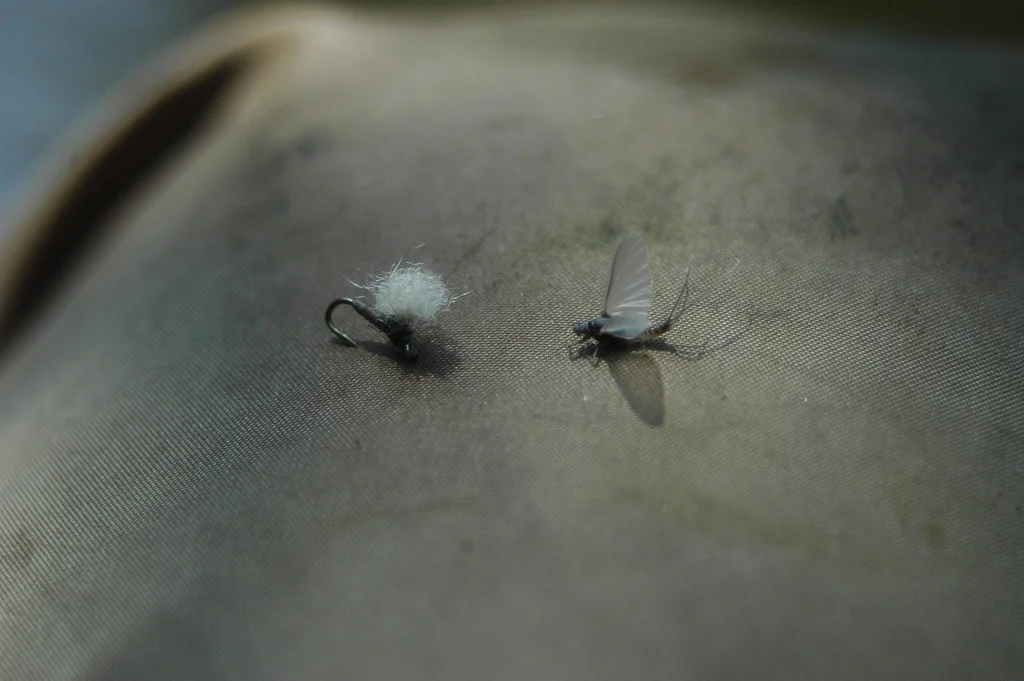
Tricos: The Maddening Hatch
Thousands of rising fish, none of which want what you're throwing.
Welcome to the Trico Hatch
The Trico hatch is many anglers' favorite and most hated fishing experience simultaneously. Here's the setup: a warm summer morning, slow water, fish rising everywhere, a spinner fall of tiny mayflies blanketing the surface. Fish are visibly feeding, constantly, all around you. And they won't eat your fly.
This is the Trico experience. It's technically demanding, occasionally infuriating, and when it clicks — when you finally put the right fly in the right lane with a clean enough drift and a fish comes up and takes it — it feels like an achievement.
What Tricos Are
Tricos (Tricorythodes spp.) are a genus of very small mayflies that hatch in massive numbers on warm-season mornings. Despite being tiny (sizes 18-24), they produce some of the most reliable and extended hatch activity of the season. The spinner fall — which follows the hatch quickly on the same morning — often involves thousands of insects and dozens of actively rising trout.
The Life Cycle and Why the Spinner Fall Is Everything
The Hatch
Trico duns hatch from the water surface like other mayflies, but they're so small that dry fly imitation of the dun is difficult and usually unnecessary — the spinner fall begins quickly and that's where the fish focus their attention.
The Spinner Fall
This is the main event. Males and females spinner-fall onto the water after mating, spent adults drifting flush in the film with wings horizontal. The water surface can become visibly covered with these tiny spent flies, and trout key on them with complete intensity. They're not going to leave their feeding lane to eat your Parachute Adams.
Fishing the Trico Fall
The Fly
Spent-wing spinner patterns, sizes 18-24, black or dark olive body, white or clear wings. A CDC spinner or poly-wing spinner tied to sit flush in the film is the standard. A small black ant in a pinch — the silhouette is close enough.
The Presentation
This is where it gets hard. The fish are in flat, slow water. They can see everything. Your leader needs to be long and fine — 12 feet at minimum, 6X or 7X tippet. The drift needs to be perfectly drag-free.
Reading the Rise
Trico rises are deliberate and rhythmic. Watch a fish for a moment before casting. They'll often establish a regular beat — rise, drift, rise again — and you can time and aim your cast to intercept the next one.
Practical Notes
If you're seeing fish rise but nothing taking your fly, and it's a summer morning, check for a Trico spinner fall — the insects may be hard to see at first.
Go small. If a size 20 isn't working, try 22. If that doesn't work, try 24.
Drag is the enemy. A single microdrag will result in refusals. Get close enough for a short, clean drift rather than fishing from far away with a long cast.
The hatch is largely over by 10 AM. Plan to be on the water early.
Recommended fly patterns
Each will also have a fly tying recipe.
- Nymph: Black Beauty
- Emerger: Trico Bunny Dun
- Dry / spinner: Drowned Trico Spinner