Understanding what's on the menu — and when — is the fastest way to fish smarter.
The Short Answer Nobody Wants to Hear
Ask ten fly fishers what trout eat, and nine of them will say "bugs." They're not wrong, but they're not entirely right either. The complete answer is closer to: whatever is most available, most nutritious, and least effort to eat at any given moment. Trout are opportunists with preferences, and understanding those preferences is one of the most useful things you can develop as an angler.
Here's the practical upshot: fish that are actively feeding are almost always feeding on something specific. Your job, every time you step into the water, is to figure out what that something is. That means understanding the food sources available to trout across different water types, seasons, and conditions — and then making your fly look enough like one of them to close the deal.
This guide lays out the whole food web. Think of it as the overview. Each section links to a deeper article on that topic.
The Foundation: Aquatic Insects
Aquatic insects are the primary food source for trout in most rivers and streams, by volume and by frequency. They're not the whole story, but they're the center of it, and no piece of knowledge will serve you better than a solid understanding of the four main insect orders.
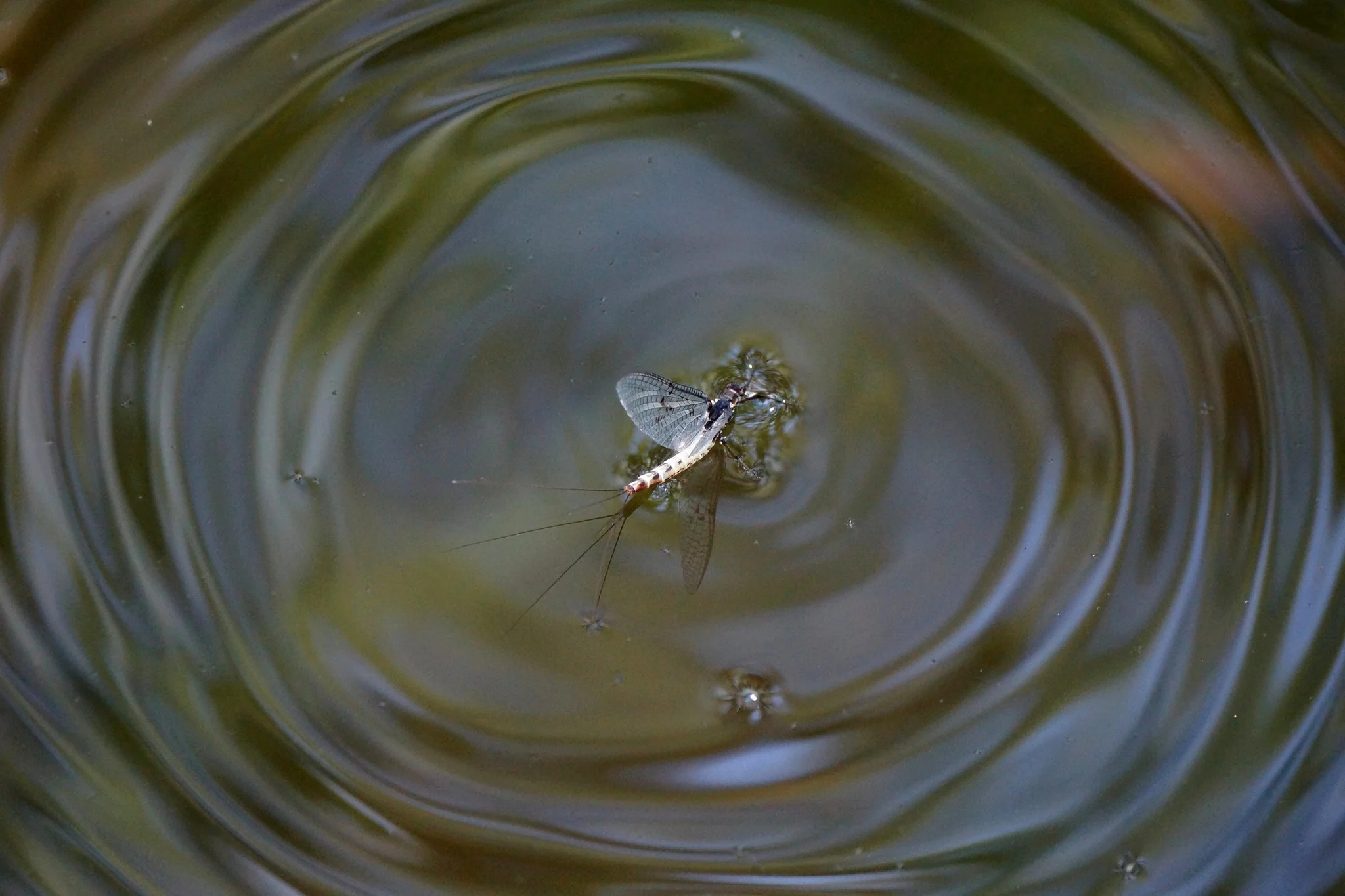
Mayflies (Order Ephemeroptera) are the canonical fly fishing insect — the one most anglers picture when they think "matching the hatch." They go through incomplete metamorphosis: egg, nymph, dun (the winged adult that emerges on the surface), and spinner (the mated adult that returns to the water to die). Trout eat them at every stage, and selective feeding on a specific mayfly stage in clear water is the technical dry fly fishing situation that makes people buy expensive rods.
Caddisflies (Order Trichoptera) are underrated by beginners and well-loved by experienced anglers. They go through complete metamorphosis — larva (which builds cases of sand, gravel, or sticks on the stream bottom), pupa (which rises to the surface to emerge), and adult. The pupal emergence is often explosive and chaotic, with fish crashing the surface in a way that looks nothing like the sipping rises of a mayfly hatch.
Stoneflies (Order Plecoptera) tend to be big — some species are among the largest aquatic insects around — and they're important in fast, high-gradient freestone streams. The giant Salmonfly hatch on Western rivers in late spring draws trout (and anglers) out in force. Unlike mayflies and caddis, most stoneflies crawl to streamside rocks to emerge rather than hatching on the water.
Midges (Order Diptera) are small, often very small, and dismissed by anglers who haven't suffered through a technical midge situation. They hatch year-round — including in winter when nothing else is going on — and in tailwaters and spring creeks they can be the primary food source for months at a stretch.
Tricos deserve their own mention despite being a mayfly. Tricorythodes are tiny (size 18 to 24) but hatch in massive numbers on warm summer mornings, often producing some of the most technical and frustrating dry fly fishing of the year.
→ Deep dives: Mayflies, Caddisflies, Stoneflies, Midges, Tricos
Baitfish: When Trout Go Predatory
Here's something that surprises a lot of people: big trout are not primarily insect eaters. A brown trout pushing 20 inches is burning a lot of calories every day, and it can't sustain that on midges. Large trout shift toward a predatory diet — eating small fish — and this changes everything about how you fish for them.
The forage species vary by region, but the usual suspects in trout streams include sculpin, juvenile trout (yes, big trout eat small trout), dace, shiners, and chubs. Streamers — large flies tied to imitate these baitfish — are the tool for targeting big fish, requiring a different approach: longer rods, heavier tippet, aggressive retrieves, and a willingness to cover water rather than targeting specific fish.
What makes baitfish an interesting target: the feeding behavior is triggered by different conditions than insect-based feeding. High, off-color water that makes nymphing or dry fly fishing difficult can actually be prime streamer water. Low light — early morning, late evening, overcast days — triggers predatory behavior.
→ Deep dive: Baitfish and streamer fishing
The Opportunists: Eggs, Mice, Worms, and Other Surprises
Trout are not purists. They eat what's available and what makes caloric sense. Some of the most effective patterns in fly fishing imitate things that don't fit neatly into "aquatic insect" or "baitfish."
Eggs are a significant food source during salmon and steelhead spawning runs and during trout spawning. A single redd can produce enough loose eggs to create a feeding lane downstream, and trout stack up below spawning fish to take advantage.
Worms and annelids become available to trout primarily during high water and rain events, when earthworms are washed from streambanks into the current. A San Juan Worm is one of the most mocked and most effective flies in existence. After a heavy rain, don't be too proud for it.
Mice and other surface prey are a niche but legitimate food source for large brown trout, primarily at night. Mouse patterns fished on a dead drift or with a wake target trophy fish in darkness — a whole subculture of fly fishing that most anglers never explore and a few become obsessed with.
Hoppers, beetles, ants, and terrestrial insects fall from streamside vegetation throughout summer and fall. Hopper-dropper rigs — a foam hopper as an indicator with a nymph trailing below — are among the most versatile summer setups around.
→ Deep dive: Eggs, worms, mice, and terrestrials
Seasonal Patterns: When Fish Eat What
The single most useful mental model for understanding trout feeding is seasonal. What's available changes throughout the year, and trout adjust. If you understand roughly what should be on the menu in any given month, you can make better decisions about fly selection and approach before you even reach the water.
Early season/winter: Midges dominant, slow deep nymphing, occasional BWOs on warm afternoons.
Spring: Water warms, caddis hatches begin, stoneflies on lower-elevation rivers, fish become more aggressive.
Early summer: Peak insect diversity — PMDs, Green Drakes, Golden Stones, caddis overlapping.
Midsummer: Trico mornings, terrestrial afternoons, streamer evenings. Fish early and late.
Fall: BWOs return, streamer season peaks for large browns, terrestrials persist into September.
Winter: Midges, small nymphs, deep slow drifts, patience rewarded.
→ Deep dive: Seasonal feeding patterns
After the food web: the confidence fly
Knowing what fish eat does not mean you will always see it. Glare, distance, empty seine nets, and plain gaps between hatches are normal. A confidence fly is the pattern you commit to when you still need to fish but observation has stopped giving you a clean answer. The article is about fixing depth and drag before you burn another hour re-sorting your box.
→ Read: The confidence fly
How to Use This
The goal of understanding fish diet isn't to turn you into an entomologist. It's to give you a framework for the most important question in fly fishing: what are they eating right now?
That question should be running in the background every time you're on the water. Look at the surface. Watch the rise forms. Check the streamside vegetation for hatching insects. Turn over rocks if you have a moment. The more you build up this knowledge — season by season, river by river — the faster your answer time gets, and the more often that answer is right.
The articles below go deeper on each part of the food web. Start with whatever's relevant to where you're fishing next.