The First Look
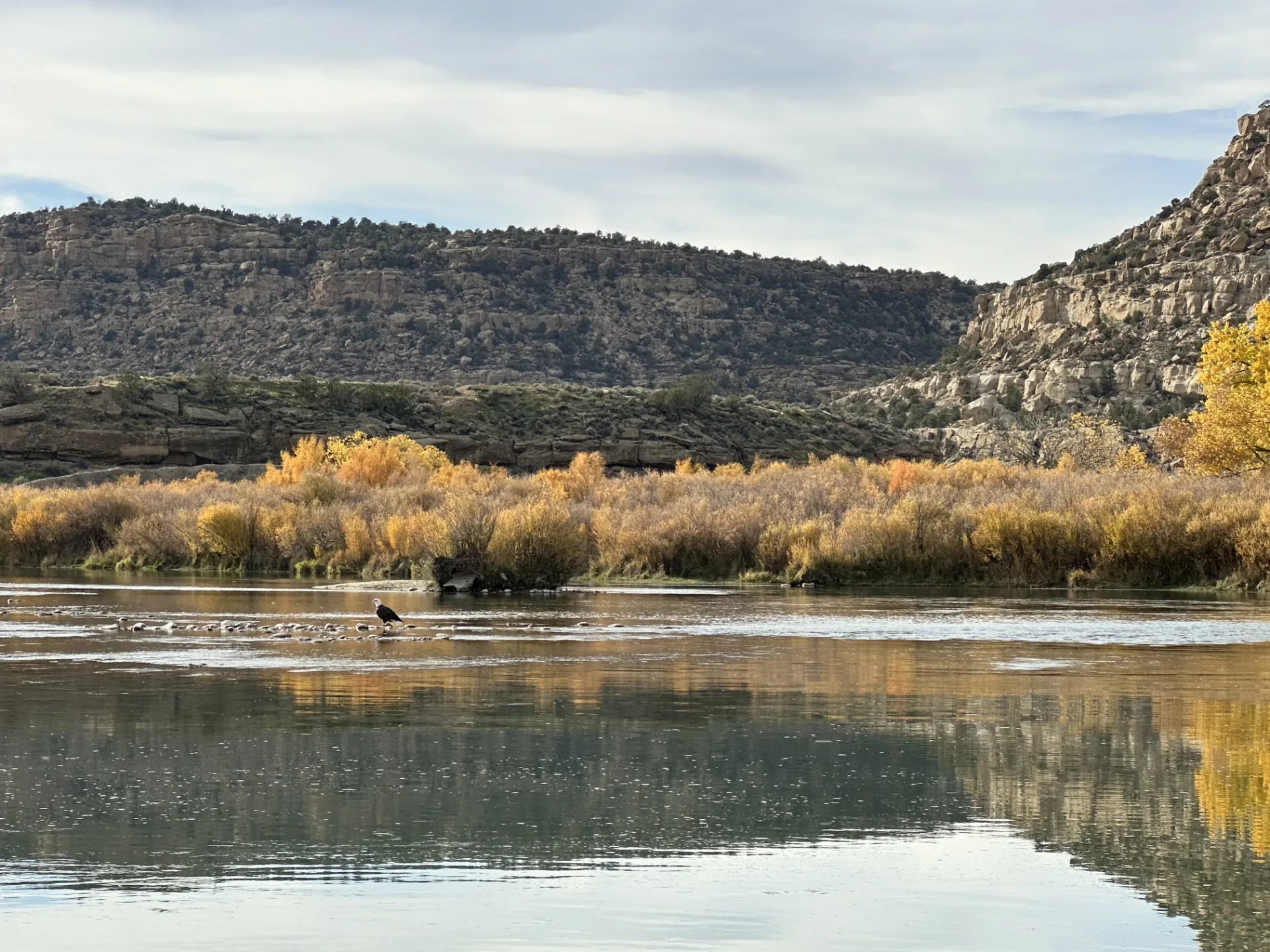
The San Juan doesn't look like what you expect when you pull off the road near Navajo Dam. You're in the high desert of northwest New Mexico — scrubby sage, red and brown sandstone bluffs, dry air, big sky. Then you walk to the river and there it is: cold, emerald-clear water running through a shallow canyon, cottonwoods lining the banks, and trout. A lot of trout.
The contrast between the arid landscape above the canyon and the lush, cold river below it is one of the things that makes the San Juan feel like a discovery every time you show up, even after twenty years. Red sandstone walls, green water, rising fish. It's a good combination.
How Sal Found It
Twenty years ago, Sal's cousin called from Albuquerque and told him about a tailwater below Navajo Dam that was worth the drive from Denver. Sal went, struggled, and kept going back. His first five years, he regularly made the trip from Colorado and returned home empty-handed or with one or two fish for the long weekend.
That's the San Juan in a nutshell — and also why it's worth learning. A river that beats you for five years and keeps drawing you back is teaching you something. Sal eventually figured out what it was asking for, and now he's one of the anglers who drives past the crowded sections early in the morning to reach water that hasn't been pressured yet.
His best day: over 100 fish. His hardest: zero fish over a full long weekend. Both happened on the same river.
The Water
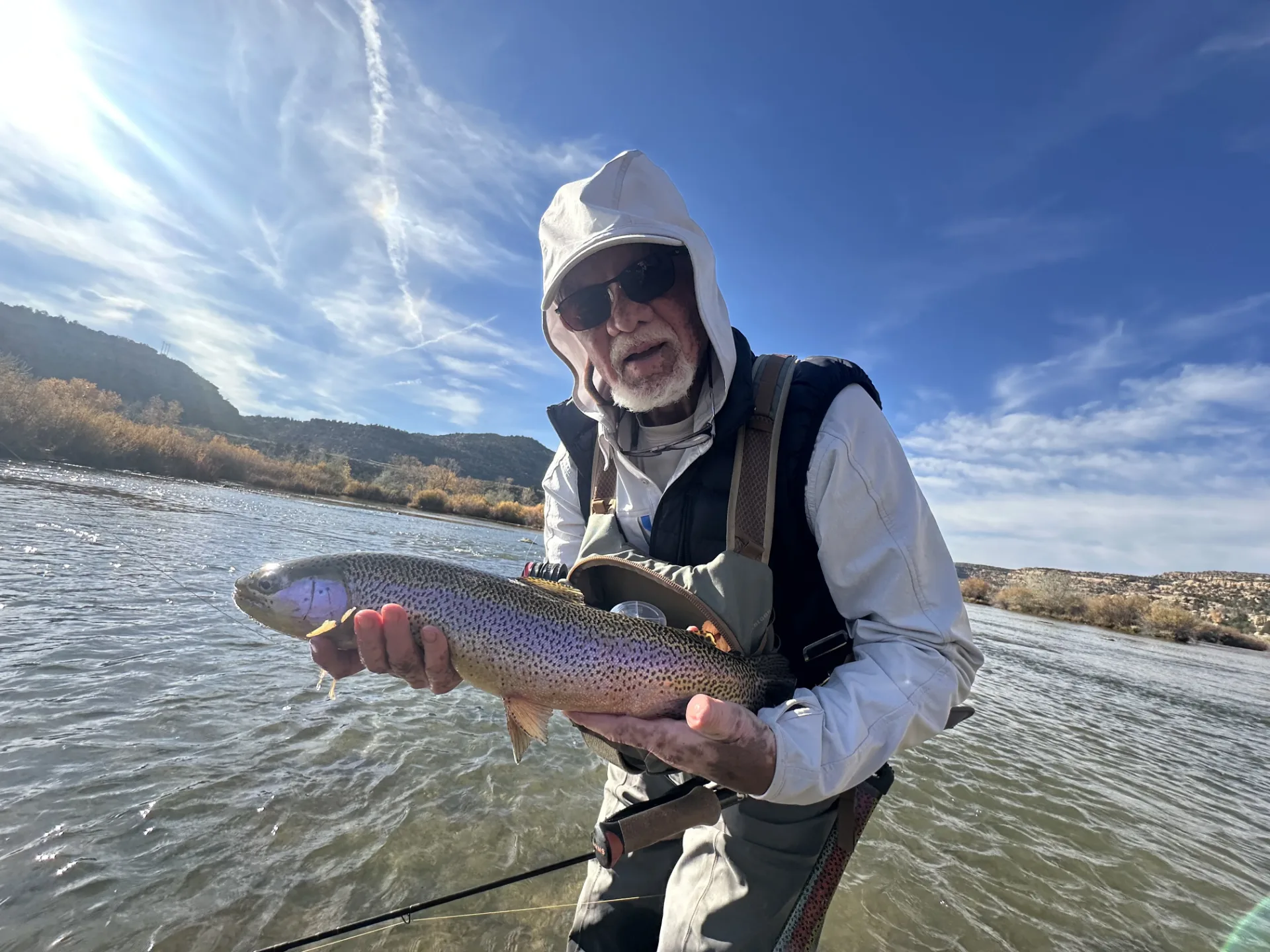
The fishable water below Navajo Dam runs through a low-gradient canyon — easy walking, mostly shallow and wadeable, with the kind of clear water that lets you see every fish and every refusal. The river is divided into designated fishing sections, all well-marked, with drive-up access to the main parking areas and short walks to the water. There's also a boat ramp and float option for anglers who want to cover more water.
The Cable Hole, just downstream from the dam, is the most heavily fished section and produces consistently — including a concentration of stocked fish near the take-out that run smaller than the wild trout further upstream. Walk past it. The further you go, the fewer people you'll share the water with. The Crusher Hole, further downstream, rewards the walk.
Flows matter on the San Juan. At 300 CFS — a common spring release — the river is wading-friendly and 3.2mm beads are more than heavy enough to get flies down. Above 500 CFS the main channel gets difficult to wade in most sections. Check the gauge before you go.
The Fish
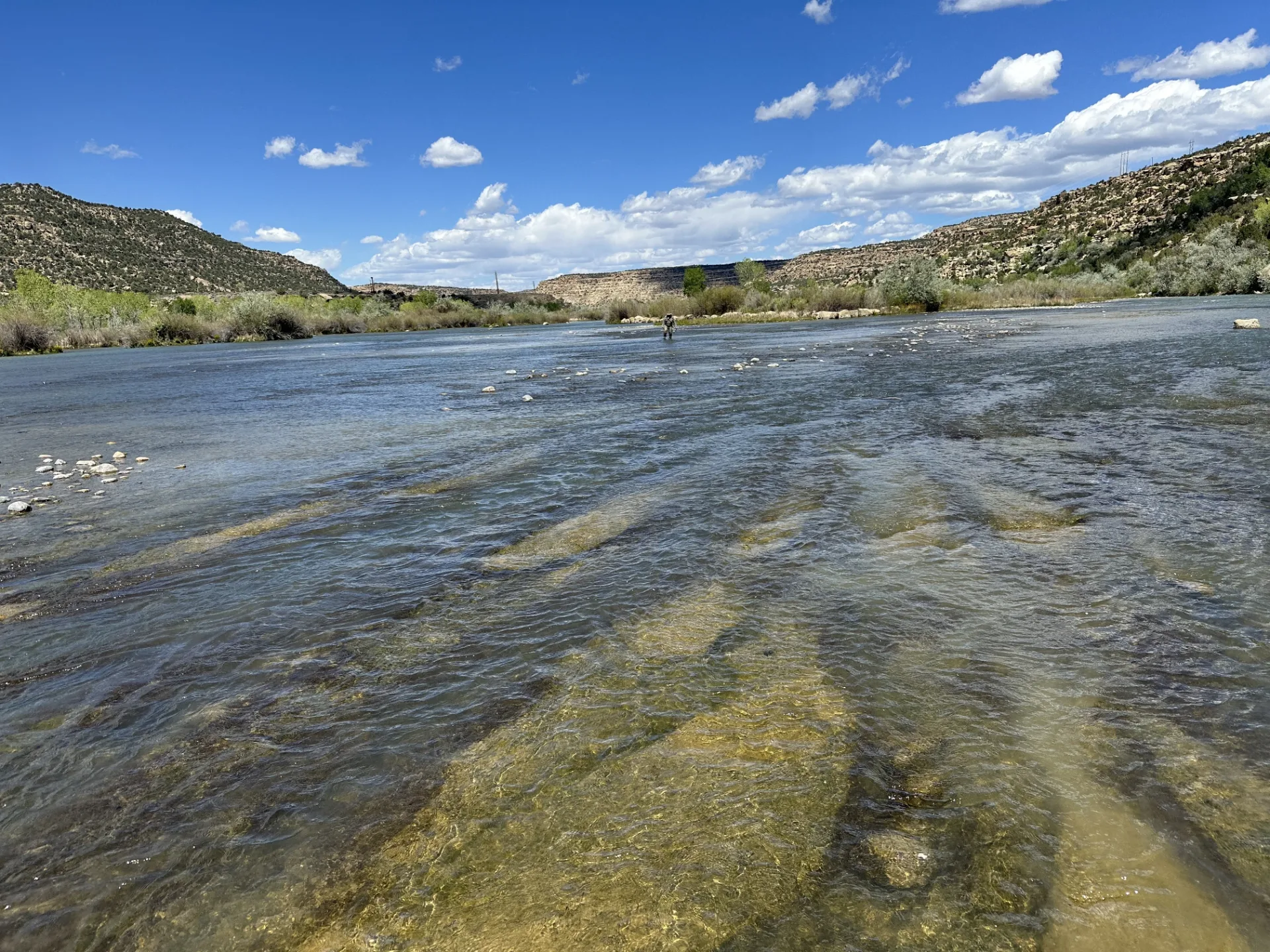
Rainbows are the primary target, with brown trout mixed in throughout and the occasional cutthroat. The wild fish average around 17 inches, which on most rivers would be a great day. On the San Juan it's a normal one. A 20-inch fish is genuinely common. A 24-inch fish is achievable on any given trip if you're fishing the right water at the right time with a reasonable presentation.
Near the boat ramp take-out, at Crusher Hole, stocked rainbows in the 10 to 12-inch range are abundant and willing as Sal calls it. Fine for a beginner or anyone who needs a confidence day. If you drove from Denver for big fish, keep walking.
Sal's goal every trip is to catch a larger fish than the year before. He knows they're there. That's the thing about the San Juan — you can see them.

The Seasons
Spring is Sal's first choice. The rainbow spawn brings fish into the shallows, the crowds haven't arrived yet, and an overcast morning in early spring is close to ideal conditions. In March 2025, on the final day of a High Plains Drifters club trip, Sal pulled a beautiful brown trout from the bottom of Texas Hole on a size 22 red annelid — his go-to fly all week. Everyone caught fish. That's a typical spring trip on the San Juan when you know what you're doing.
When the club goes in April, Sal comes prepared. For Euro nymphing anglers, his spring box includes Eggstacy eggs in peach or cheese on size 14 hooks with 2.8mm and 3.2mm beads; quill body perdigons in size 16 with 2.4mm silver beads and size 18 with 2.0mm silver beads; midge perdigons in black, olive, and cream on size 20 hooks with 2.0mm black nickel beads; red annelids on size 18 and 20 with 2.0mm tungsten red beads; Lil Bit Mays in black or olive for Baetis; and jig leeches in black or dark olive with 3.2mm beads.
Fall is the brown trout spawn, which shifts the dynamic entirely. Big browns that spent the summer in deeper water become aggressive and territorial. In November 2023, Sal and his son Jordan fished Texas Hole on a Friday — slow, the big fish not cooperating — then moved to the Kiddie Hole on Saturday in high-60s weather and caught around 20 fish each on small Pheasant tail sizes 18 and 20. The stockers at Crusher hole are in the 10 to 12-inch range were willing. The lesson: when Texas Hole is slow, move. There's more river than most visiting anglers ever see.
Midsummer is the toughest time to go. Heat, crowds, and fish that have been heavily pressured since spring. If summer is your only option, fish early and stay late. The window between 9 AM and 5 PM is when the river is most crowded and the fish are least cooperative.
What's on the Water
The San Juan has more food sources than most tailwaters, and understanding what's available — and where — changes your approach significantly.
- Midges are the year-round staple. They're always there, always hatching in some form, and the fish eat them constantly. This is the foundation of San Juan fly fishing.
- Annelids and aquatic worms are the other constant, particularly close to the dam where stomach pumps consistently reveal them. The San Juan Worm was named for this river for a reason.
- Blue-Winged Olives hatch in spring and fall, most reliably below Texas Hole on overcast days. The standard tailwater BWO pattern applies here — worse weather, better hatch.
- Egg patterns work year-round on the San Juan because of constant-temperature releases that keep fish reproducing. They're most effective during the rainbow spawn in spring and brown trout spawn in fall, but don't leave them out of the rotation in other seasons.
- Leeches produce year-round, especially in fall and winter and in any off-color or higher water conditions. Fish them on a dead drift, jig, swing, or strip.
- PMDs and Caddis appear in the lower stretches through summer — the further you get from the dam, the more these insects matter.
- Hoppers follow the same geography. Close to the dam, fish don't see them as often. Work your way downstream and hoppers become a legitimate summer option, especially along the banks.
- Large flying ants are a San Juan-specific phenomenon. During the first monsoons of summer, ants wash off the sandstone cliffs above the river in enormous numbers. When it happens, fish go to the surface aggressively. Carry large ant patterns in summer — size 14 to 16 — and be ready.
- Baitfish — sculpins and fingerling trout — are most relevant in the lower stretches. Streamer fishing in that water, particularly in fall, can find the biggest browns in the river.
Sal's Fly Box
Twenty years of San Juan trips have produced a clear list. If Sal could only carry ten patterns:
- San Juan Worm, #14–20 — Red, tan, orange, wine, purple, pink. Named for this river. Imitates the aquatic annelids that fill trout stomachs near the dam. Non-negotiable.
- RS-2, #18–24 — Gray, chocolate, black with CDC or foam wing. Works as a nymph, emerger, or dry. Imitates midges and mayflies. Works everywhere, works especially well here.
- WD-40, #18–24 — Chocolate and gray, with or without flashback. Developed by a Durango guide. Fishes the same as the RS-2 across multiple stages. One of the most versatile flies on the river.
- Flash Midge Pupa, #18–26 — Black, gray, brown. Usually the first fly Sal ties on. Trout are always eating midges. The flash can be trimmed if fish are being tight-lipped.
- Annelid, #18–22 — Red, orange, brown. Smaller and more precise than a San Juan Worm. If you pump a trout's stomach close to the dam, annelids are almost always there.
- Egg Pattern, #14–20 — Pink, cerise, orange, apricot, yellow. Year-round effectiveness because of the river's constant temperature and fish reproduction. Best during spawn windows but never out of rotation.
- Griffith's Gnat, #14–26 — The standard midge dry fly. When midges cluster into rafts on the surface, a large Griffith's Gnat imitates the clump better than a single-fly imitation.
- Pheasant Tail, #18–24 — Standard or flashback. Sal's BWO nymph of choice on the San Juan.
- Leeches, #8–12 — Olive, black, blood leech, Canadian olive, white, tan, gray. Buggers, bunny leeches, chamois leeches — the style matters less than the silhouette. Dead drift, jig, swing, or strip depending on conditions.
- Midge Perdigon, #20 — Black, olive, cream, 2.0mm black nickel bead. For Euro nymphing and tight-line rigs. Drops fast, stays in the zone.
Gear
For the midge and nymph fishing that defines most San Juan days: a 3, 4, or 5-weight rod with a long leader and fine tippet. The fish are educated and the water is clear — 6X is a starting point, 7X is not unusual when fish are being selective. For fall streamers targeting brown trout, Sal switches to a 6-weight.
Euro nymphing anglers should note that at typical flows around 300 CFS, 3.2mm beads are the ceiling — you don't need heavier to get flies into the zone.
Drink water. The high desert at elevation is dehydrating even when it doesn't feel hot. Sal carries more than he thinks he'll need and has learned this the hard way.
The Local Knowledge
Two things Sal took years to figure out:
Fish early and stay late. The window between 9 AM and 5 PM is the worst time to be on the San Juan — most crowded, most pressured fish, hardest conditions. Get on the water before 7 AM. The best spots are claimed early and the fish haven't been spooked yet. In the evening, the crowds thin and the fish relax.
Walk past the easy water. The San Juan is full of fish. It's also full of anglers fishing the same accessible sections within a short walk of the parking lot. Every hundred yards you walk past the crowd is worth something. Sal walks. It's made the difference.
On the Difficulty
The San Juan has a reputation for being technical, and it earns it. Sal went home blanked for five consecutive years before the river started giving up fish consistently. That's not unusual for anglers new to it.
The variables are real: presentation has to be precise, tippet has to be fine, fly selection matters, and the fish have seen a lot of flies. But the fish are also there in extraordinary numbers. A bad day on the San Juan is still a day on a river full of large, visible trout.
When Covid closed the river to out-of-state anglers, Sal's reaction was immediate: it sucked. That's the clearest possible endorsement.
If You're Going for the First Time
Do your homework before you leave. Check flows at the Navajo Dam gauge. Look at water temperature. Find out what's hatching that month. Show up with midge patterns in sizes 18 through 26, a San Juan Worm in multiple colors, and egg patterns. Get on the water before 7 AM. Walk further than feels necessary.
The fish are everywhere on the San Juan. The mistake is standing in the first good-looking spot and not moving.
Quick Facts
- **Location: **Below Navajo Dam, near Navajo Dam, NM
- **Access: **Drive-up parking with short walk to water; multiple designated fishing areas; boat ramp available
- Species: Rainbow, brown, occasional cutthroat, carp
- Average fish: 17 inches wild; 10–12 inches near take-out (stocked)
- Great fish: 24 inches and larger
- Best flows: Under 500 CFS for wading; 300 CFS typical spring release
- Best seasons: Early spring (rainbow spawn), late fall (brown trout spawn)
- Key flies: San Juan Worm, RS-2, WD-40, Flash Midge Pupa, Annelid, Egg Pattern, Griffith's Gnat, Pheasant Tail, Leeches, Midge Perdigon
- Rod: 3–5 weight for midge/nymph; 6 weight for streamers
- Tippet: 6X–7X
- Nearest town: Navajo Dam, NM (Farmington, NM for lodging and supplies)
- Local resource San Juan Fly Shop, Navajo Dam